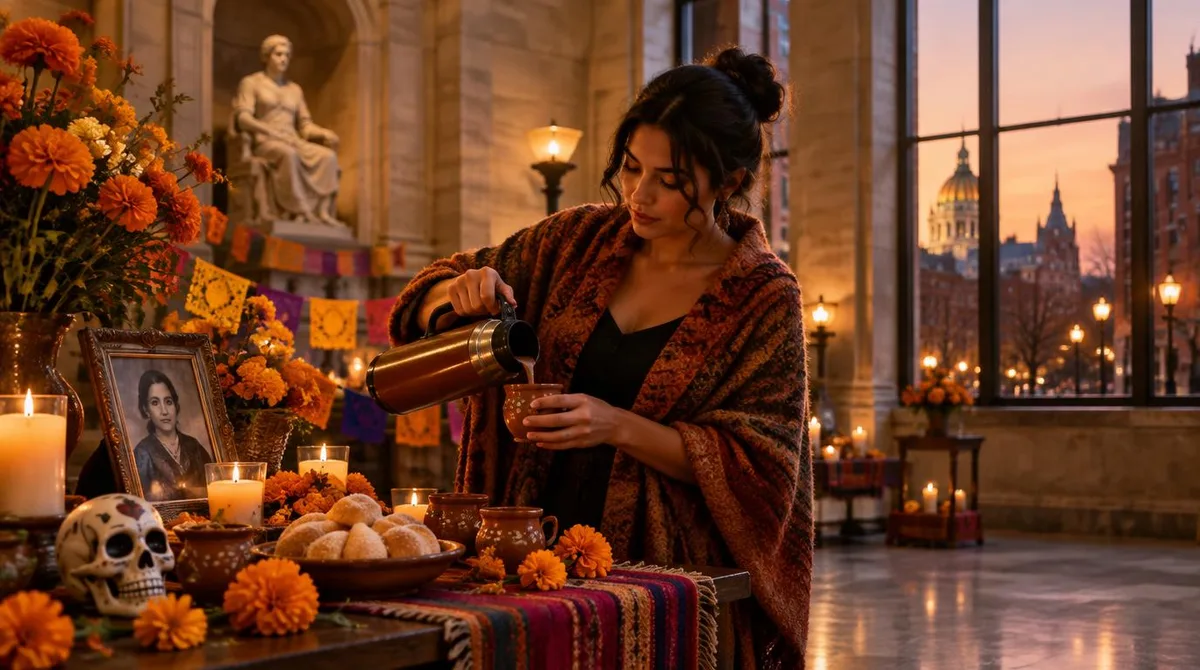
Evy Ruiz usually earns her living from a vintage trailer. On Saturday, 1 November, she will pour Mexican hot chocolate for free, for likely hundreds of people, at the fourth annual Helena Casita Day of the Dead Celebration in Hartford. Admission is free too: the event runs at the Wadsworth from 10 a.m. to 2 p.m., with art, music and crafts built around remembrance, according to the Hartford Courant.
The economics of the day are worth pausing on, because almost nothing about it charges anyone anything. Ruiz's mobile business, Hasta Luego Friend, is her income. Yet she will serve her hot chocolate without taking money for it, inside a celebration that costs its visitors nothing at the door. The organiser, Helena Martinez, has spent months preparing, including crowdfunding, to keep it that way.
That combination, a paid maker giving her work away and a free public event funded piecemeal, is how many grassroots cultural gatherings actually hold together. It is a different model from the ticketed fair, and readers weighing the arithmetic of selling versus showing may find our breakdown of what a craft fair stall really costs a useful counterpoint. We covered a connected angle in What a Craft Fair Stall Really Costs Once You Count Everything.
What happens at the celebration, and who is welcome
Día de Muertos, the Day of the Dead, began as a Mexican tradition and spread through the wider Latin community. The Courant notes that people from other cultures came to know it widely through the 2017 Pixar film "Coco". Martinez, who organises the Hartford celebration, hopes people of all cultures come out. "Grief is something we all experience, and we all deserve spaces where we can remember the people," she told the Courant. "You don't have to be Mexican or have prior knowledge of the tradition to join us."
The centrepiece is the ofrenda, the altar families build with photographs, flowers, food and other offerings to welcome the departed home. Attendees who want to make one are asked to bring their own items. Around the altars sit the crafts, art and music that give the day its shape, and the hot chocolate Ruiz will be serving.
Martinez describes her own relationship to the tradition as ongoing. "I'm still learning about this tradition every year through books, articles, conversations, and people I meet, especially those from Mexico who share their knowledge and experiences," she said. "For me, it's about remembrance, celebrating life, and uplifting Mexican culture and community."
Why Ruiz is pouring for free
Ruiz will be remembering her grandfather, her grandmother, and a sister who died in her early twenties. "It makes me feel happy because we start to reminisce," she told the Courant of the holiday. "It helps me stay motivated."
Motivation is not an abstract word for her. She is a full-time caregiver for her grandmother, who is on hospice care and often comes along for the ride, while also running the coffee trailer. The free pours on 1 November sit inside a working life, not beside it.
The business behind the free cups
Hasta Luego Friend, whose name translates as "See you later", has no permanent location. Ruiz travels in her blue 1974 Scamp trailer, announcing on social media where she will turn up, and deliberately parks outside bakeries, bodegas and other businesses that do not serve coffee, to boost their trade as well as her own. She serves hot and cold coffee, matcha refreshers, teas and hot chocolate; her mother makes virgin coquito, a coconut-based Puerto Rican drink, that can be added to any of them.
On her website, Ruiz, whose full first name is Evelyn, describes herself as "a queer Puerto Rican born and raised from Hartford". She writes that in April 2023 she left corporate America after 17 years, prompted to turn "adversity into opportunity" by founding the business. Her inspiration, she writes, is rooted in her grandmother Evelyn and her great-grandfather, who owned a bodega and Latin restaurant in the 1970s that was lost to fire. "Café, to me, is more than a coffee, it's love, listening ears, and peace," she writes.
Her stated mission is collaborative rather than extractive: partnering with local businesses that share her values, working with coffee farmers for fair practices, and building a network of bakeries and shops "dedicated to community, quality, and giving back." Makers thinking about how their own values translate into pricing and selling, without giving everything away, may find our guide on pricing handmade work a practical companion piece.
What a free event buys a community
The numbers in this story are small and human: a fourth annual edition, a four-hour window, one trailer, likely hundreds of visitors. But the pattern they sketch is recognisable. A museum opens its doors without charge. A small business donates its product. An organiser crowdfunds the rest. Culture gets made in the gap, and remembrance gets a public room.
Martinez puts the invitation plainly: the day is a chance to learn, celebrate cultural traditions and "connect with others through our shared experiences of love, loss, and remembrance." For readers elsewhere tracking how museums and community programmes open up access, our report on The Box, Plymouth winning Art Fund Museum of the Year 2026 covers a similar spirit on this side of the Atlantic. For related coverage, see The Box, Plymouth Wins Art Fund Museum of the Year 2026.
If you are in Hartford on 1 November, the celebration runs from 10 a.m. to 2 p.m. at the Wadsworth. Bring altar items if you want to make an ofrenda. The hot chocolate is free, and so is the welcome.