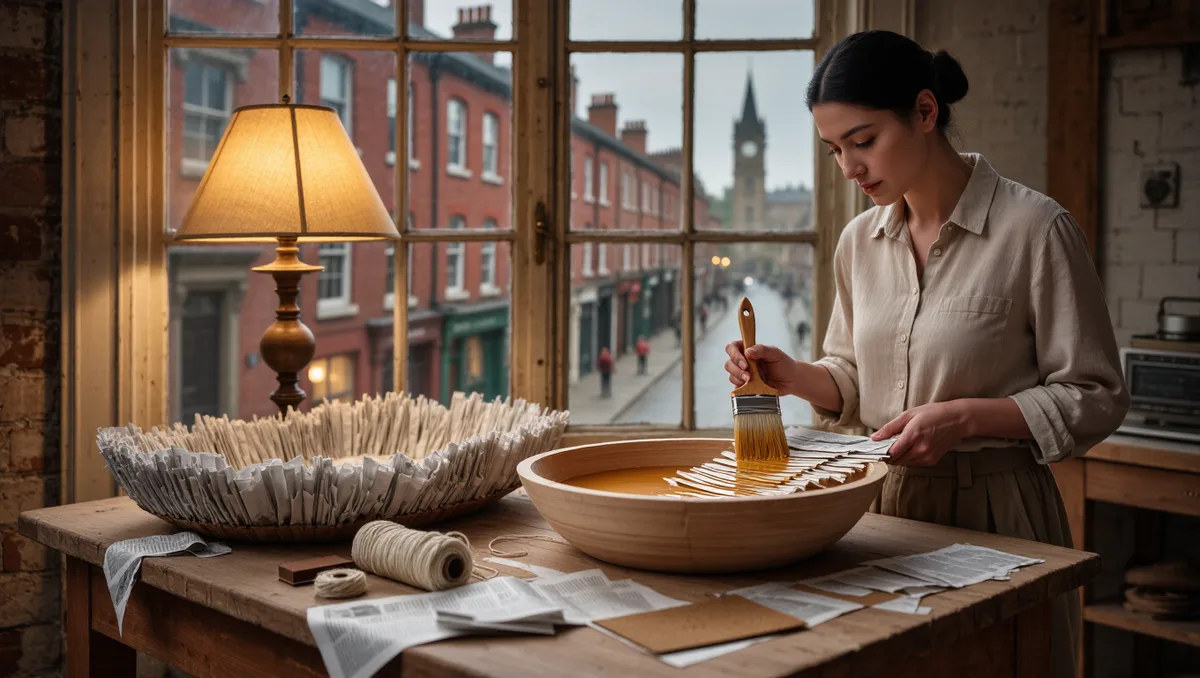
Old newspaper, torn into strips and pasted in layers, dries into shells and panels strong enough for real work. The result is papier-mâché, a craft with roots in ancient China and a golden age in Victorian Birmingham. The best newspaper crafts for adults treat those free sheets like timber: laminated, moulded, sanded and finished until the newsprint becomes something a room can be proud of.
The appeal is not hard to explain. The material costs nothing, forgives clumsy hands and rewards patience, and the finished trays, bowls and vases sit happily on a modern shelf. The honest caveat is drying: layers set at their own pace, so a piece grows over several short sessions rather than one evening. Our crafts news hub follows the paper and book arts year round, and papier-mâché keeps earning its place there.
Why does soft newsprint set so hard?
Layering does the work. Paper torn small and mixed with water and a binder — glue, starch or wallpaper paste all appear in the standard recipes — dries into a shell that keeps whatever shape it was pressed over. The encyclopaedia entry for the craft describes “a pulp ideal for modelling or moulding, which dries to a hard surface”, and that is exactly the quality makers rely on. Laminated strips built up in crossing layers behave like thin plywood once dry (Wikipedia).
The pedigree is serious. In 1772 the English inventor Henry Clay patented laminated sheets of papier-mâché treated with linseed oil to produce waterproof panels, and his process was said to let the material be “sawn, planed, dove-tailed or mitred in the same manner as if made in wood”. Clay, a japanner, had apprenticed with the typographer John Baskerville and was a supplier to the Royal Family.
What did the Victorians build with it?
Mostly trays, it turns out, alongside chair backs and structural panels. Theodore Jennens patented a steam-pressing process in 1847 that pushed laminated sheets into shaped moulds, and the resulting trays and chair backs were laid over wood or metal armatures for strength. The surfaces were smoothed and lacquered, or given a pearl-shell finish, and the Birmingham trade ran through the nineteenth century. A zero-budget tray, in other words, keeps royal company.
Which projects suit a first weekend?
Shape decides how elegant a piece looks, so begin with forms that flatter the material.
- A laminated bowl, built in crossing strips over an upturned glass bowl, sands back to a smooth, lacquer-ready shell.
- A rolled-tube tray, woven from tight newspaper tubes, echoes the Birmingham trays at no cost.
- A pulp vase, pressed over a bottle and left to dry, takes paint and gilding wax beautifully.
- A framed wall panel, cut from thick laminated board, shows off gilded edges.
To see where paper craft goes in professional hands, visit a studio in person. Open studio events run across the British year, and our open studios events guide explains what to expect, what to ask and how to plan a route with room for the unexpected.
Does a craft hoard undo the recycling?
Not really, and the science explains why. Recycling works by pulping used sheets, and after repeated processing the fibres become too short for new paper, which is why virgin fibre is often added to the mill recipe (Wikipedia). A sheet that serves first as a bowl has simply done two jobs before the pulper. The industry learned the trick long ago: deinking, the process that strips printing ink from recycled fibres, was an invention of the German jurist Justus Claproth.
Conclusion: elegance is a finish, not a budget
Newspaper asks for patience rather than money, and history shows how far that patience travels — from Clay’s waterproof panels to lacquered Birmingham trays with pearl-shell surfaces. Choose a shape you like, laminate slowly, sand honestly and finish with varnish. The shelf will never guess the material cost nothing. We covered a connected angle in What Studio Space Really Costs British Makers — and How to Climb the Ladder Slowly.