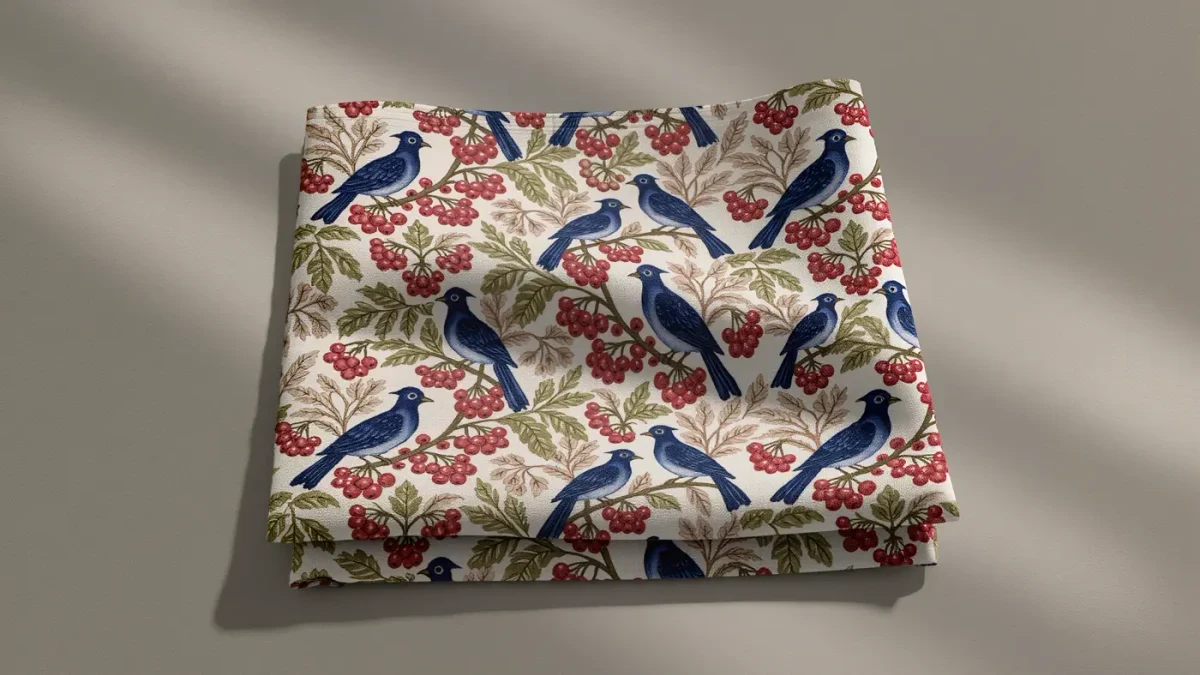
William Morris (1834–1896) printed his first wallpaper, Trellis, in 1864, and within two decades had turned pattern-making into a philosophy. His rules — that ornament needs a structure the eye can follow, that motifs should be drawn from living plants rather than invented, and that a repeat must look logical from any distance — still shape British surface design, from heritage wallpaper ranges to the work of young illustrators who have never read a word he wrote.
Who was William Morris, and why does one Victorian still matter?
Morris was a designer, poet, dyer, weaver, printer and socialist reformer, and the driving force of the British Arts and Crafts movement. In 1861 he founded the decorating firm that became Morris and Co, producing wallpapers, textiles, stained glass and furniture that rejected what he saw as the shoddy excess of industrial manufacture. His outrage was productive: if machines made badly designed things cheaply, he would make well designed things slowly, learning each craft from its foundations — dyeing, block cutting, weaving and printing — until he understood them from the inside. That combination of moral seriousness and hands-on skill is why design schools still teach him as a founder of the discipline.
What are the pattern rules Morris actually set out?
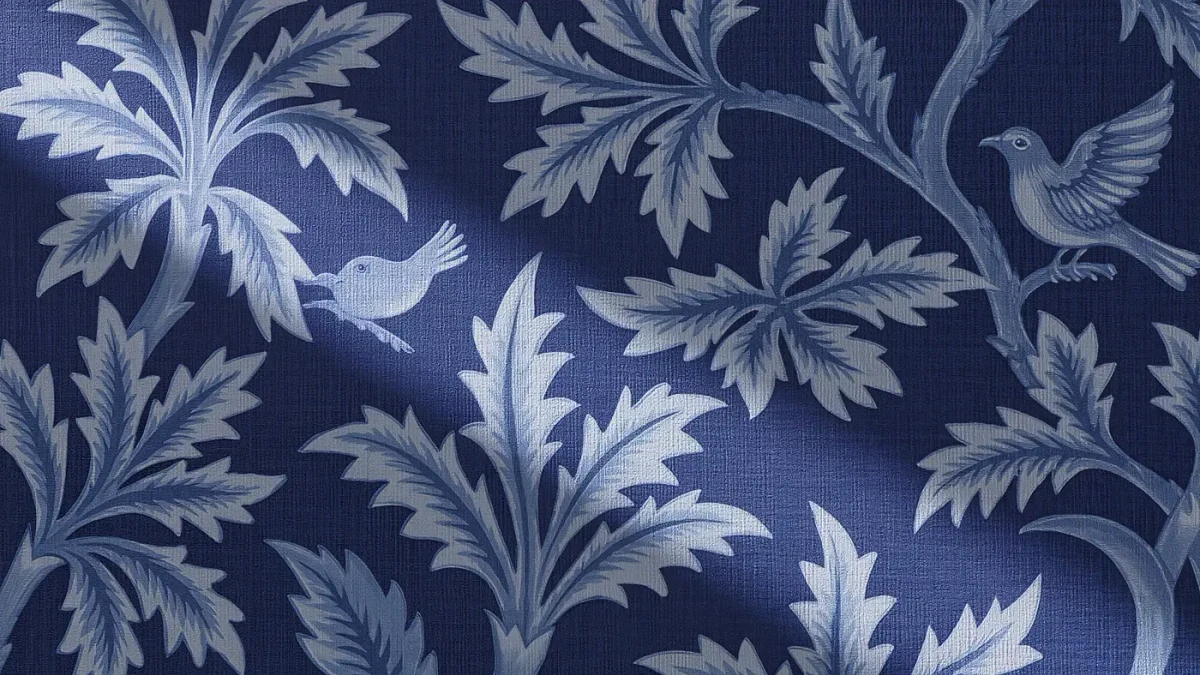
Morris explained his principles in lectures, above all The Lesser Arts of 1877 and Some Hints on Pattern-Designing of 1881, and the rules are strikingly practical. A pattern should have a clear framework the eye can grasp — in his wallpapers, strong vertical stems carry the design upward like a trellis. Motifs should alternate, turn and counter-turn so the surface never repeats a single rhythm twice in a row. Dark and light must balance carefully, because a pattern that turns to mush from across a room has failed at its first job. And ornament should suggest nature rather than imitate it photographically: a Morris leaf is a leaf disciplined by order, never a botanical illustration. Underneath all of it sits one commandment — pattern must suit the object it decorates, or it is merely noise.
How were Morris patterns actually made?
By hand, at a scale that is hard to imagine. Wallpapers were printed from carved pearwood blocks, one block for each colour, registered onto the paper with small locating pins. A complex pattern meant a dozen blocks or more, each printed in turn, each requiring a separate pass and a separate drying. In 1881 Morris moved production to Merton Abbey, a former silk works on the River Wandle in south London, precisely because the site had its own water supply for washing and dyeing cloth. There he mastered indigo dyeing, and in 1883 the firm produced his most famous textile, Strawberry Thief, by a demanding indigo-discharge method: cloth dyed a deep, even blue, then bleached and over-printed where the pattern would appear. The design took its name, with typical Morris affection, from the thrushes that raided the fruit beds at his country home, Kelmscott Manor.
Which designs became permanent fixtures?
A small canon carries the firm's reputation. Trellis of 1864, his first wallpaper, was drawn with the help of his friend the architect Philip Webb, who supplied the birds. Willow Boughs of 1887 shows his late, serene simplification — catkins and willow leaves on a calm diagonal. Strawberry Thief remains the pattern most people can name, printed in several colourings and endlessly reinterpreted. What unites the canon is not the motifs but the logic beneath them: strip away the flowers and a rigorous grid of stems and counter-curves remains, which is exactly why the patterns survive translation onto wallpaper, fabric, mugs and phone cases without collapsing into prettiness.
Where do the rules surface in design today?
Almost everywhere surface pattern is taken seriously. The originals are still in production under licence, printed from the firm's records, and the broader revival of craft printing in Britain — block printing workshops, natural dyeing courses, small studios cutting their own blocks — traces a direct line back to Merton Abbey. Contemporary pattern designers may work on a tablet rather than at a dye vat, but the questions Morris asked have not aged: where is the structure, where is the contrast, what does the design look like from four metres away, and does the motif deserve its place? Even the current appetite for plant-dyed, botanically drawn, small-batch pattern is essentially Morris's programme restated for a new century, something profile pieces gathered by BBC Culture have noted more than once when tracing the lineage of British craft.
What can any designer borrow from Morris?
- Draw from life. Morris filled sketchbooks with real plants observed in real gardens, and the difference shows in every curve.
- Build the framework first. Set the stems, the grid and the rhythm before adding a single flower.
- Judge at distance. Pin the work up and step back four metres; if the structure vanishes, the structure is wrong.
- Alternate everything. Directions, weights, densities — the eye tires of any rhythm repeated unbroken.
- Respect the making. A design should be possible to print, weave or embroider beautifully, not merely to draw.
Morris wrote that one should have nothing in one's houses that one did not know to be useful or believe to be beautiful, and the phrase has been worn smooth by repetition precisely because it compresses his whole argument. A pattern, for Morris, was never decoration added at the end; it was a small piece of social argument about how things should be made and how makers should live. That is the deeper reason his rules endure — they were never only about flowers.