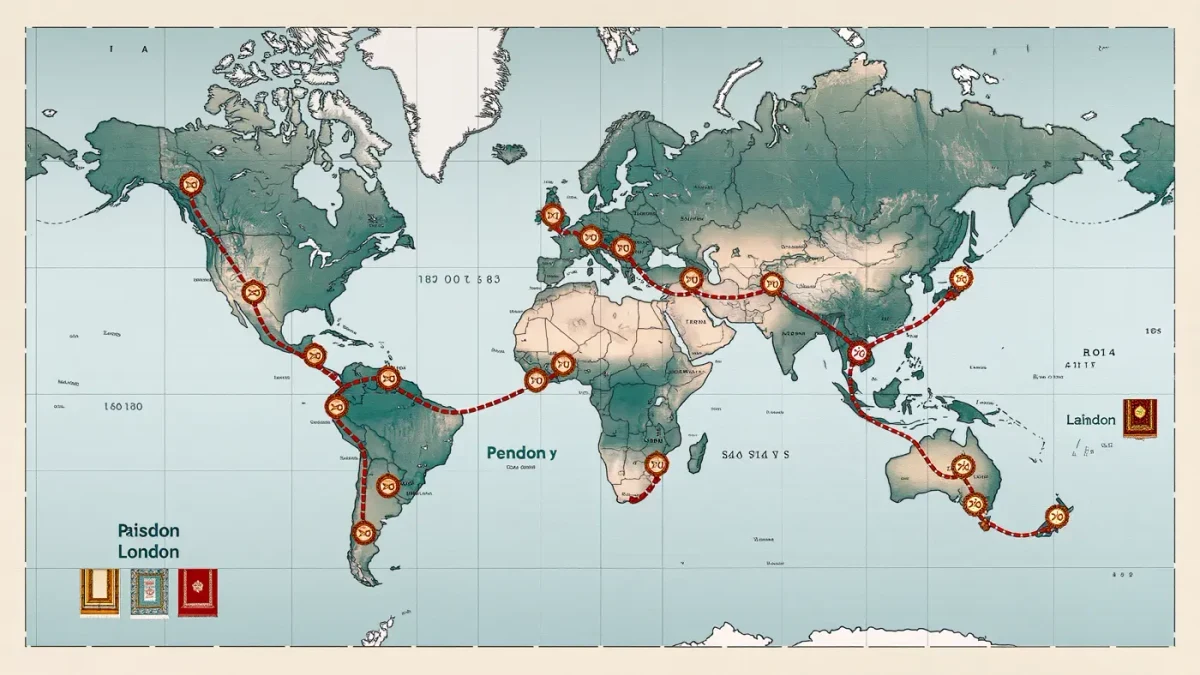
The paisley motif is a traveller. It begins as the boteh, a bent shoot or bud shape found in Persian textiles from at least the sixteenth century, moves into the woven shawls of Kashmir, and reaches Britain toward the end of the eighteenth century in the luggage of East India Company trade. By the 1820s the mill town of Paisley, near Glasgow, was weaving the pattern so successfully that it gave the motif the name the West still uses.
Where did the boteh begin?
In the courts of Persia, where the boteh — the Persian word for a small shrub, bud or blossom — appears embroidered and woven from the Safavid period onward. Its meanings have been argued for centuries: a cypress bent by the wind, an ancient symbol of life bent but unbroken; a sprouting shoot; a stylised almond or mango; a flame. What is certain is the shape's staying power. A curved, teardrop-like form with one end pulled to a hook proved endlessly adaptable — small enough for a border, grand enough for a shawl's centre — and Persian weavers and embroiderers carried it along the trade routes of Asia in cloth, the medium motifs have always travelled by.
How did the motif reach Kashmir?
Through the weaving workshops of the Kashmir valley, whose famous shawls took the boteh to incomparable refinement. Kashmiri shawls were woven, not embroidered, in a demanding weft-faced twill technique in which every element of the pattern was built weft by weft on the loom, with dozens of tiny coloured threads tracked by individual weavers working from a coded design. A single shawl could take eighteen months to two years to complete. Under Mughal patronage the boteh grew from a sparse border mark into the dense, curved cone that fills the shawl's long field, and these textiles — diplomatic gifts as much as merchandise — moved outward along every route from Central Asia to the Ottoman world and, eventually, to Europe. design coverage.
Why did Britain fall for Kashmir shawls?
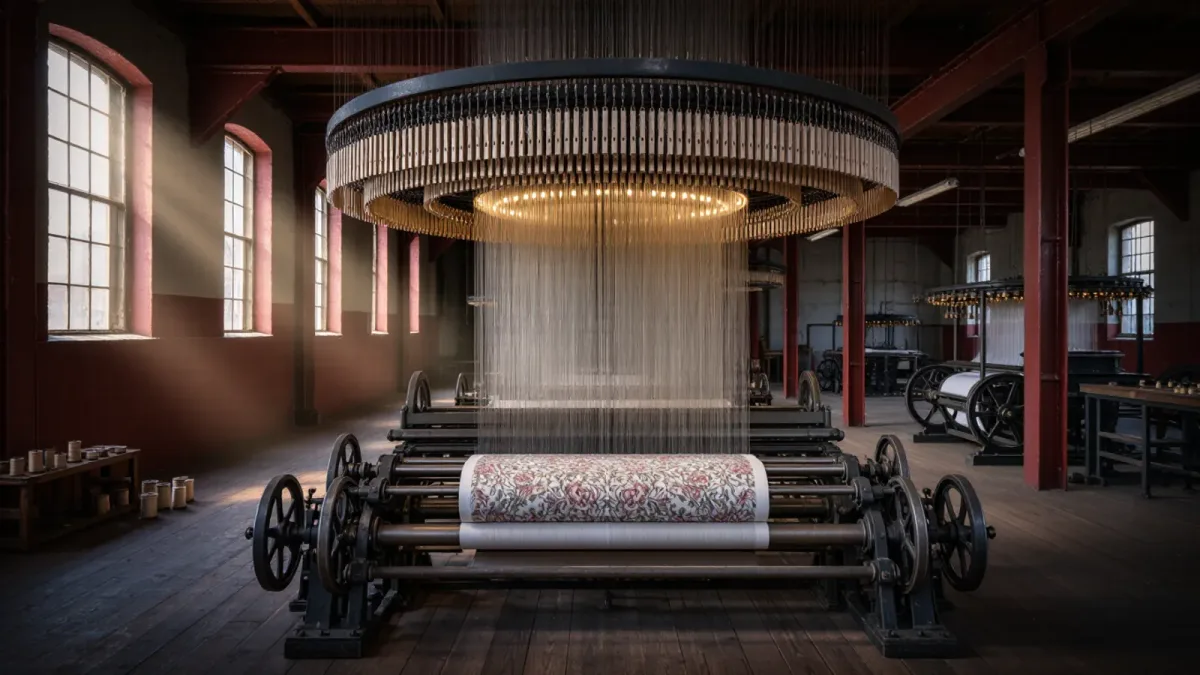
Fashion, empire and accident. Shawls brought back from India by East India Company officials in the later eighteenth century became extraordinary status objects; on the continent the Empress Joséphine famously collected them in quantity. British and French mills saw the demand and set out to imitate the Kashmir shawl at a fraction of the cost. Edinburgh and Norwich were early centres from around 1805, but the town of Paisley had the weavers, the looms and the aggressive pricing to dominate. Its makers wove plain shawl grounds and employed specialist embroiderers and, from the 1820s, the new Jacquard mechanism — the French head, introduced after Joseph-Marie Jacquard's invention of 1804, which read patterns from punched cards — so the complicated boteh figures could be produced far more cheaply than by hand.
What did the Jacquard loom change?
Everything about the price, and something about the pattern. Hand-woven Kashmir shawls were heirloom investments; Jacquard-woven Paisley shawls were serious but attainable purchases, and the middle classes bought them in enormous numbers. The loom also changed the drawing. European designers, competing to make their shawls more splendid than their neighbours', elongated and curdled the boteh, adding floral fringes and architectural detail until the motif reached a Victorian richness far from its Persian reserve. It is one of the clearest cases in textile history of technology quietly redrawing a motif.
Why did the great trade collapse?
With astonishing speed in the 1870s. Fashion turned from the full shawl to the fitted jacket, which could not display one; the Franco-Prussian War disrupted continental markets; and a famine in Kashmir in 1877 shattered the original weaving industry. Paisley's shawl trade fell from thousands of looms to a remnant within a decade, and the town turned instead to thread and other textiles. Museums on both sides of the Atlantic hold the evidence of the boom and the collapse — fine Kashmiri originals sit beside British imitations in collections worldwide, and the Smithsonian's open-access collections allow the two traditions to be compared shawl by shawl, border by border.
How did the motif outlive its shawls?
By shrinking. Once the great shawls passed out of fashion, the boteh emigrated to smaller goods: cravats and ties, scarves, handkerchiefs, bandanas, dressing gowns and vestas. The 1960s gave it a conspicuous revival in menswear and the era's psychedelic graphic language, after which it settled permanently into the classic wardrobe. Tie makers found the curved cone suited a bias-cut silk; furnishing designers found it suited dense, richly coloured velvets and wallpapers; and printers found it worked at any scale, from a pocket-square border to a full furnishing repeat. Each generation rediscovers it, because the shape itself carries its appeal — a curve that suggests growth, and a hook that leads the eye round again.
What does the route of one motif teach designers?
That motifs behave like seeds: they travel in whatever carries them, take root where the conditions suit, and grow into new forms that their originators would barely recognise. The boteh survived because each culture along the route found a new use for it — Persian embroidery, Kashmiri weaving, Scottish industrial looms, twentieth-century neckwear. No committee directed any of this. The lesson for a designer today is humility and encouragement in equal measure: draw something good enough to travel, and let the route do the rest. The boteh left Persia as a bud on a border and arrived, four centuries later, on a Glasgow loom as a garden — and nothing about the shape ever stopped meaning something.