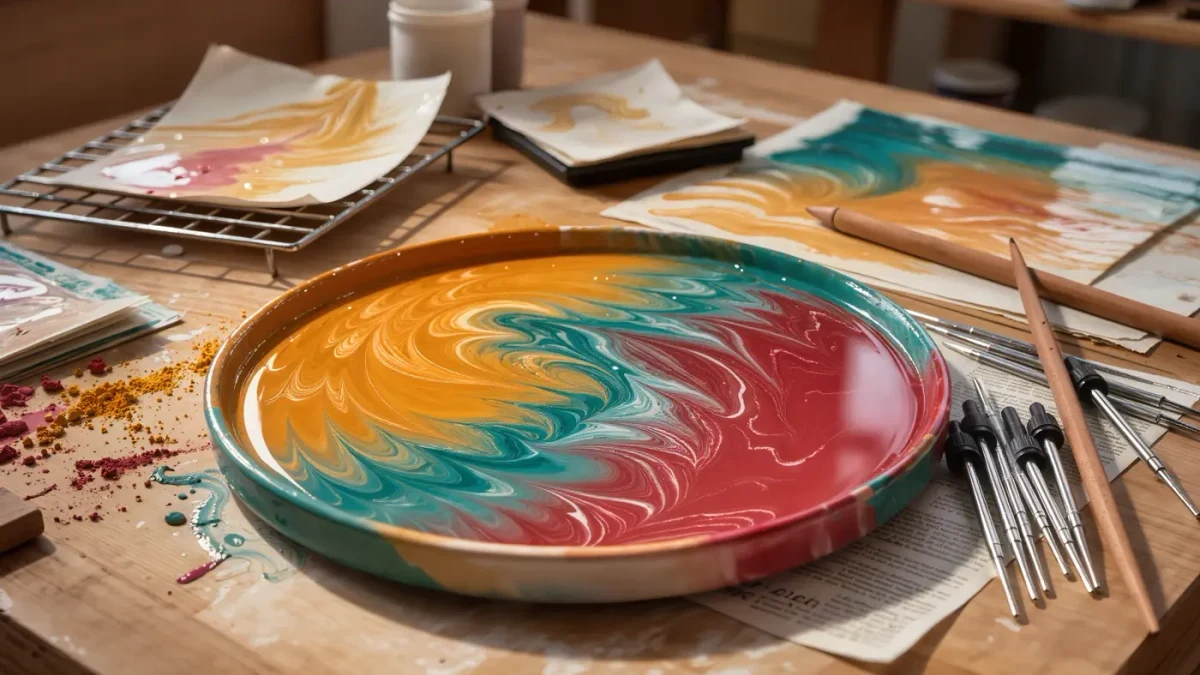
Paper marbling for beginners starts with a carrageenan bath: seaweed extract whisked into water to the feel of runny honey and rested until the bubbles clear. Pigment dropped onto the thickened surface spreads into circles, a comb draws them into patterns, and alum-treated paper lifts the finished design away. Mix the bath at two heaped teaspoons of carrageenan per litre.
Why does marbling need a thickened bath?
On plain water, most pigments either sink or scatter untameably; the surface tension is too weak to hold a design. Carrageenan — an extract of red seaweed, long used as a thickener — gives the water body. Dropped colours sit on the surface, spread into predictable discs and stay exactly where the rake leaves them, so patterns can be drawn rather than merely hoped for. The thickened water is called the size, and it is the single ingredient that separates satisfying marbling from a muddy puddle.
The technique itself is old and remarkably cosmopolitan: suminagashi, the Japanese art of floating ink on water, reaches back to the twelfth century; ebru developed in the Turkish and Persian worlds; and European binders marbled endpapers for books from the seventeenth century onwards. Historic marbled endpapers digitised in the Library of Congress collections show how little the basic mechanics have changed — the same float, draw and lift recorded in centuries of bookbinding.
A bath lasts usefully for a day or two if rested and skimmed between sessions, and the size can be gently re-thickened if it thins overnight. Marblers learn to read their bath the way cooks read a pan: how a drop lands, how fast a circle grows, when the surface has gone quiet and is ready for colour.
What equipment does a marbling table need?
A kitchen counter, some newspaper and this list:
- One shallow tray, 3–5cm deep, at least 5cm wider and longer than the paper
- About 30g of carrageenan powder for a first bath
- 100g of alum, for treating the paper
- Six small pots of fluid acrylic or dedicated marbling paint
- Eyedroppers, one per colour
- A stylus or thin wooden dowel, and a comb made by fixing pins at even intervals along a strip of wood
- Twenty sheets of cartridge or marbling paper, 90gsm or heavier
- A sponge or wide brush for applying the alum, two rinse trays, and a clothesline with pegs
It is worth protecting the table before the first drop of paint flies: newspaper under the tray and a damp cloth within reach keep a session moving. Marbling rewards preparation within minutes, because the interval between a finished pattern and a printed sheet is measured in seconds, not tea breaks.
How do you marble paper with the carrageenan method?
- Whisk the carrageenan into lukewarm water — two heaped teaspoons per litre — until fully dispersed, then rest the mixture for at least four hours, ideally overnight, so it clears and thickens. Pour 3–4cm into the tray and skim any remaining bubbles from the surface with a strip of newspaper.
- Treat the paper: dissolve about 15g of alum in 250ml of warm water, sponge the solution evenly over one side of each sheet, mark the treated corner lightly in pencil, and let the sheets dry completely.
- Thin the paints to the consistency of cream. Test a single drop on the rested bath — it should spread into a visible circle within a second or two, not sink, not sit as a tight bead.
- Drop colours from about a centimetre above the surface, a few drops of each in turn. Each new drop lands inside the last and pushes the earlier rings outward: this is the stone pattern, and it is already a finished design.
- Draw the pattern: stroke a stylus once through the bath for concentric circles, then draw a comb slowly across in a single unhurried pass for the nonpareil, or zigzag the stylus lengthwise first for the chevron. One pass per gesture — the bath remembers every touch.
- Lower a sheet, alum-side down, from one edge across the bath, letting it settle without trapped air. Pat any dry corners gently, count to ten, then lift the sheet from one corner in one continuous peel.
- Rinse the sheet briefly in clean water to wash away the size, peg it to the line, and let it dry — an hour or two to handle, overnight under weights or heavy books to press it flat again.
Why do colours sink or prints wash out?
A bath too thin is the usual culprit behind sinking colours: if the size feels like water, the pigment rides straight through it. Whisk more carrageenan in, rest, and test again. Paint thinned too little behaves the same way, heavy with binder and unable to spread, so bring everything to the consistency of cream and no thicker.
Pale, ghostly prints almost always mean the alum was skipped, applied too lightly, or dried onto the wrong side of the paper — hence the pencil mark. Distorted patterns usually trace back to a disturbed bath: fingers breaching the surface, a breeze across the tray, or a rush on the lay-down. Marbling rewards a still room and unhurried hands, and punishes both like few other crafts.
In exchange it offers something rare: a technique where the first honest attempt is genuinely beautiful, and the tenth is unrecognisably better. Sheets marbled in an afternoon can endpaper a journal, wrap a gift or simply be kept — most marblers keep far more paper than any sensible project requires.