A pair of designer shoes is a promise that the making inside them matches the name on the box. Sometimes it does. Sometimes the label is doing most of the work. The way to tell the difference is to look past the logo and read the construction — how the upper meets the sole, what the lining is made of, and whether the details feel finished or merely expensive.
This guide walks through what lasts, what doesn't, and the checks worth making in the shop before any money changes hands. It is written for the second month of ownership, not the first: the moment when the shine has worn off and the shoe either settles into comfort or starts to show what it is really made of. This connects to our earlier piece, Design Fails Teach Us More About Good Design Than Any Textbook.
What actually makes a shoe a designer shoe?
The word covers a wide field. As Wikipedia notes, a designer is simply someone who plans the form or structure of something before it is made — and fashion design sits among dozens of specialisations that have grown out of that basic act. In footwear, that planning can mean a genuinely new last shape, or it can mean a licensed name applied to shoes made in a factory the designer never visits. Both can be sold under the same shelf heading, which is why the label alone tells you very little.
The useful question is not who designed the shoe but who made it, and how. Construction answers that. A shoe's quality lives in decisions you can see and touch: the sole attachment, the leather, the lining, the finishing. Those are the things that survive a season of pavements.
How is the shoe put together — and why does it matter?
The joint between upper and sole is the single most telling detail. Broadly, shoes are made one of three ways, and each behaves differently over time.
- Cemented construction. The sole is glued to the upper. It is light, quick and cheap to produce, and it is how most modern shoes are assembled. The compromise is repairability: once the bond fails, resoling is often not practical.
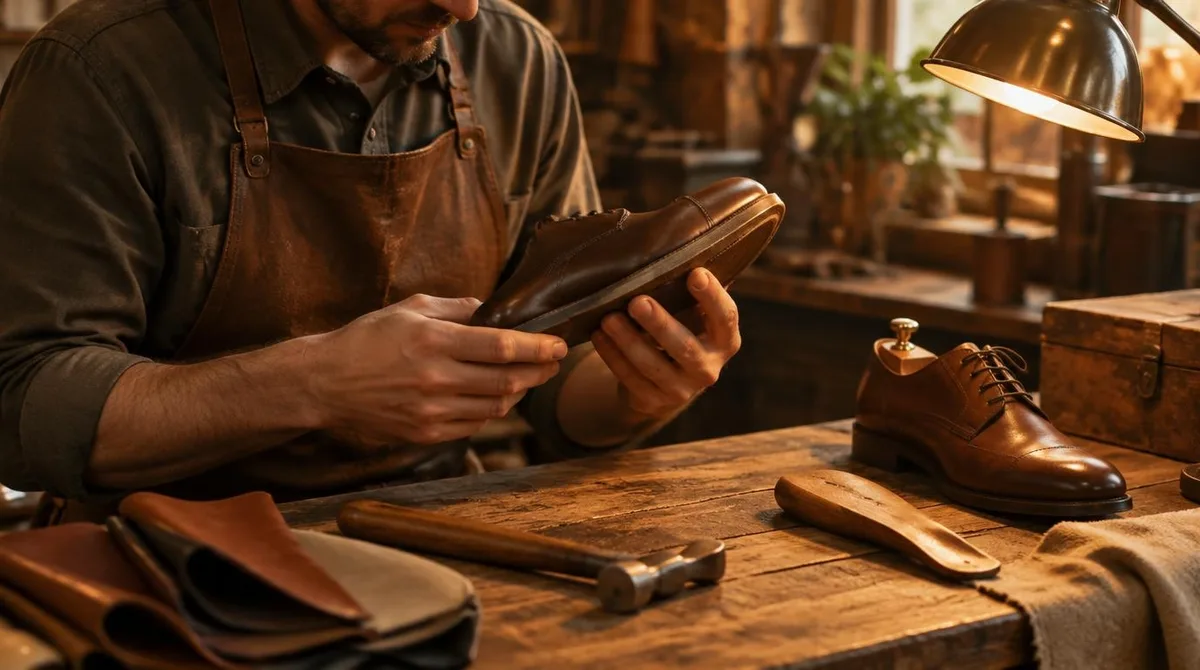
- Stitched construction. Methods such as a welt — a strip of leather that joins upper, insole and sole — sew the parts together. The shoe can be taken apart and rebuilt, which is why well-made welted shoes are often resoled rather than replaced.
- Blake and similar internal stitching. The sole is stitched directly to the insole through the upper. It makes a flexible, close-cut shoe, common in Italian dress footwear, with less water resistance than a welted build.
Turn the shoe over. If you can see stitching running around the edge of the sole, the shoe can usually be repaired. If the sole meets a smooth, sealed edge, you are probably looking at glue — fine for a light summer shoe, less reassuring for something you plan to wear through a British winter.
What should the leather and lining tell you?
Good upper leather has character you can feel. Run a thumb across it: full-grain leather shows natural variation, a slightly uneven grain, and it creases rather than cracks as it ages. Corrected leather — sanded and sealed to hide imperfections — looks uniform out of the box and often looks tired sooner. Neither is wrong; they are different price propositions. Uniformity is what you pay less for.
The lining matters as much as the outside. A leather lining wicks moisture and moulds to the foot; a fabric or synthetic lining tends to hold dampness and, in boots especially, is where shoes give up first. Check the inside edge of the heel and the tongue — if the lining is already puckering in a brand-new pair, it will not improve.
Smell helps too. Real leather has a distinct, slightly sweet smell; many synthetics smell of nothing much, or of glue. It is an old trick and it still works.
Where does the comfort actually come from?
Comfort in a shoe is mostly geometry, not cushioning. The last — the foot-shaped form the shoe is built around — decides whether the shoe suits your foot. This is where design, in the proper sense, earns its keep: someone decided where the widest point of the shoe sits, how the toebox tapers, how the heel counter grips. A well-designed last on modest materials beats a poor last on premium leather every time.
Practical checks, in order:
- Flex point. Bend the shoe. It should crease where your foot bends, at the ball, not in the middle of the arch.
- Heel counter. Squeeze the back. It should resist firmly; a floppy counter means a heel that will slip and rub.
- Twist test. Hold heel and toe and twist gently. Some give is right; a shoe that wrings like a cloth has no structure.
- Inside finish. Feel for lumps under the insole where tacks or rough edges sit. Good making hides nothing you can feel through the footbed.
Expect a breaking-in period with stiff leathers, but distinguish between stiffness and pain. A good shoe becomes comfortable; a badly shaped one stays uncomfortable however long you wear it.
What does the price actually buy?
A designer price covers several things at once, and it helps to separate them. Part is materials — better leather, a leather-lined interior, a stitched sole. Part is labour — hand finishing takes hours, and hours cost money. Part is the name itself: marketing, distribution and margin. There is no fixed ratio, and two shoes at the same price can sit in very different places on that spectrum.
Our analysis: judge each pair on its own construction rather than its brand's reputation. The same house can sell a beautifully welted derby and a cemented trainer with a synthetic lining under one roof. The name on the box is constant; the making is not. This is the same discipline we apply to buying furniture without the markup — pay for the object, not the story around it. Readers following this should also see Design Within Reach? Buying Quality Furniture Without the Markup.
Practical steps: a shop-floor checklist
Take sixty seconds with any pair before buying, and most disappointments disappear:
- Check the sole edge for stitching, and ask how the shoe is made if it isn't visible.
- Look inside: leather lining throughout is a good sign; partial lining with visible glue is not.
- Inspect the finish — even stitch spacing, clean edges, no glue traces at the joins.
- Try both shoes, on both feet, late in the day when feet are at their largest.
- Ask about repair. A shoe that can be resoled is a different purchase from one that cannot.
None of this requires expertise. It requires the willingness to turn a shoe over in a shop, which some staff find charming and none find rude.
What this means for your next pair
The evidence a shoe offers is all on its surface: construction, materials and finish are visible to anyone who looks. A stitched, leather-lined, well-finished pair from an unfamiliar maker will usually outlast a cemented, fabric-lined pair with a famous name — and cost less to keep alive. The reverse is true too, which is the honest complication. Designer shoes are neither a guarantee nor a swindle; they are a category with a very wide spread inside it. Read the making, buy the shoe, and let the label be the least interesting thing about it.