Wheel throwing for beginners begins with centring, opening and pulling — three movements repeated until they run together as one. A first bowl asks for about 500g of well-wedged stoneware clay, a wheel turning at a steady, moderate speed and roughly three gentle passes to raise the walls; the finished pot later fires at stoneware temperatures of 1,200 to 1,280°C.
What is actually happening on the wheel?
Throwing is a negotiation between stillness and spin. The wheel supplies rotation; the potter supplies a steady hand. Any lump of clay that is even slightly off-centre amplifies its own wobble as it spins, which is why centring comes first and why it defeats almost everyone for a session or two before it suddenly stops defeating them. Water is the third ingredient — a film of it between skin and clay removes drag, letting the hands glide while the clay travels beneath them.
Once the clay runs true, opening pushes a well into the centre, and pulling squeezes the walls upward between fingers inside and outside the form. The same three movements appear in every thrown pot from a tiny cup to a tall vase, which is why teachers guard them so carefully. Thrown vessels from ancient bowls to studio porcelain are documented across cultures in the Smithsonian's open-access archive.
Clay choice quietly sets the destination: earthenware fires lower and brighter, stoneware fires harder at higher temperature, and porcelain asks the most of the thrower. Most beginners start with a grogged stoneware body, which forgives handling and stands up well to heat.
Body position does half the quiet work. Sitting square at the wheel, forearms resting on the thighs and elbows braced into the torso, turns the hands into stable instruments; a slumped potter produces a slumped pot. Wheel speed stays moderate for most beginners' work — fast enough that the clay moves smoothly, slow enough that the hands can keep up with it.
What kit does a beginner potter need?
Most people meet the wheel in a class first, which is sensible; everything below is what that class will put on the bench:
- Access to a potter's wheel, by class, studio membership or a community space
- 500g to 1kg of plastic stoneware clay per attempt — 500g is plenty while learning
- A throwing sponge for carrying water to the clay
- A wire cutting tool for releasing finished pots from the wheel head
- A needle tool for trimming uneven rims
- A wooden or metal rib for smoothing and shaping walls
- A bucket of clean water, two towels and an apron
How do you centre, open and pull?
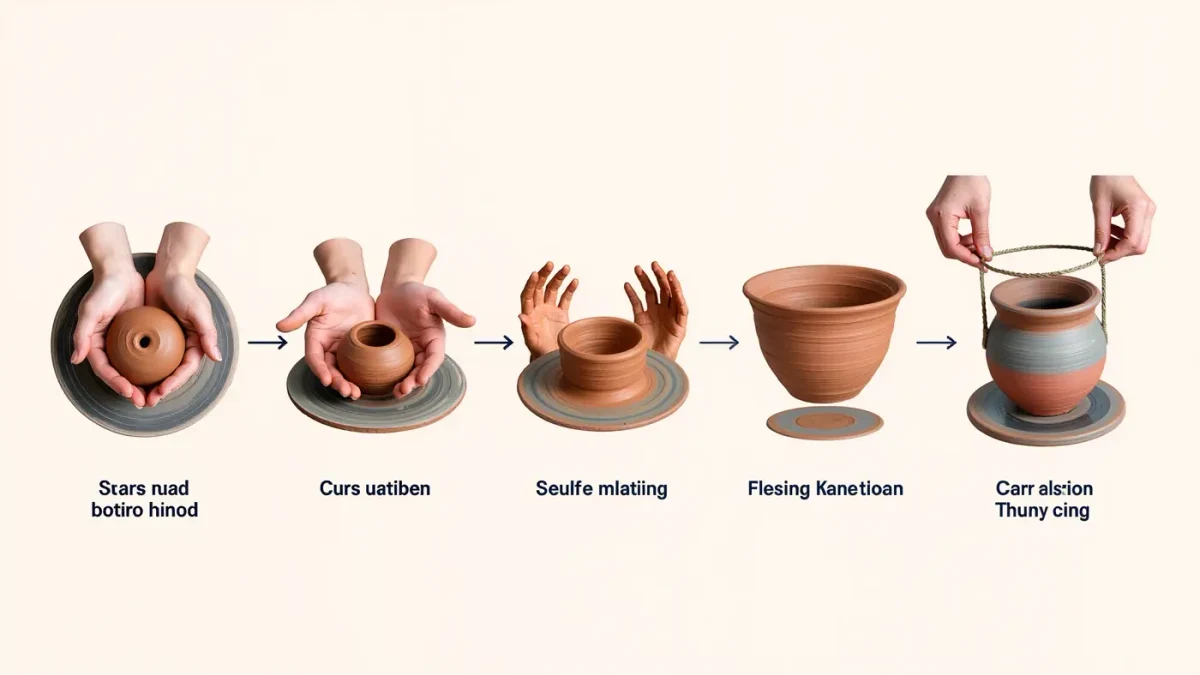
- Wedge the clay in a spiral motion to even out its moisture, slam the ball onto the centre of the wheel head, and seal the base with wet hands so no air is trapped beneath.
- Centre the clay: brace your elbows into your body, cup both wet hands around the spinning ball and cone it upwards, then press it down and out. Repeat until the clay runs silent and still — two or three minutes is normal, and the moment it runs true is unmistakable under the palms.
- Open the form: press your thumbs, or two fingers of the right hand, straight down into the exact centre, stopping about 1cm from the base — roughly the thickness of a little finger.
- Flatten and compress the base by drawing the fingers outwards from the centre in a compass movement, leaving a clean, dense floor for the pot to stand on.
- Pull the walls: with fingers inside and the outside hand braced against them, squeeze gently and travel slowly upwards. Three passes is typical, moving from thick to thin, and slowing the wheel slightly as the walls rise gives the clay time to follow.
- Shape the cylinder into a bowl or vase with a rib, sponge surplus water out of the interior, and even up the rim with the needle tool.
- Run the wire under the base, lift the pot free with dry hands, and let it dry slowly to leather-hard for trimming — then fully bone dry before a first firing around 1,000°C and a stoneware glaze firing between 1,200°C and 1,280°C.
Which mistakes slow every beginner down?
The generous ones, in order: skipping proper centring, so the wobble only grows; working dry, so the hands drag and torque the clay; and working too wet, so softened walls slump. Rushed pulls leave thick, heavy bases, while hesitating mid-pull lets the wall spiral. Every failed pot can be wedged back into use, so nothing is lost but water.
The most useful habit is small-scale repetition: ten centred 500g balls teach more than one ambitious project. Speed comes from the wheel; control comes from stillness; the hands learn both at their own pace, usually across a handful of sessions.
Trimming deserves a mention before the wheel takes over a life. Once a pot reaches leather-hard, it returns to the wheel upside down for a trimmed foot — a ring of clay cut away to lighten the base and lift the form. Many beginners postpone learning to trim and regret it later, since the foot ring is what makes a pot feel finished rather than merely thrown.
From the first centred ball onwards, the wheel stays the same honest machine: it spins, and it waits for the hands to become quiet. Nearly every potter remembers the first ball that ran true beneath their palms; every pot afterwards is a deepening of that single moment.