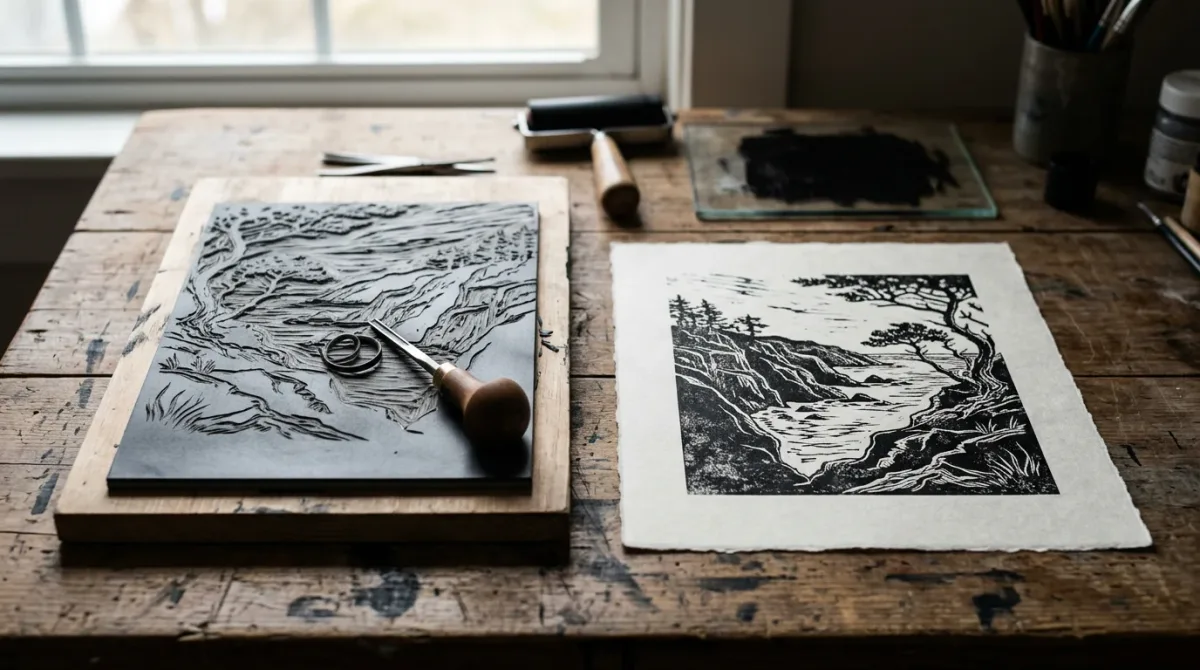
Laura Boswell, the Dumfries and Galloway-based printmaker, works almost entirely in reduction linocut, a method that consumes the very block used to make it. “A truly limited process where the print block is destroyed in creating the work,” she writes on her website — a description that puts risk and impermanence at the centre of everything she carves.
Boswell trained first in Wales, taking a joint honours degree in Visual Art and History of Art at the University of Wales, Aberystwyth, between 1984 and 1987. Her printmaking practice later carried her to Japan, where she studied traditional woodblock techniques through the Nagasawa Art Programme and MI-Lab. In 2018 she was elected an Associate of the Royal Society of Painter-Printmakers, known as RE — a London-based organisation, working from Bankside Gallery near Tate Modern, that describes itself as one of the world’s premier printmaking bodies and admits only practising professional printmakers through peer selection. That same year, the Society awarded her its Art Angels Publishing Prize.
Reduction linocut leaves no room for revision. A single block is carved and printed in the lightest colour first, then carved away further and printed again in a darker ink, the earlier colour showing only where the new cut has left it exposed — each pass destroying the block a little more until nothing is left to print from. Boswell cuts with a mix of tools that spans continents and decades: Pfeil gouges, a Powergrip handle, a Japanese hangi-to knife, and cutting tools inherited from the 1930s. She works in both oil-based and water-based inks, testing brands including Nerchau, Graphic Chemicals, Cranfield, Lukas and Lawrence Art Supplies, and thins her colour with an ink extender to build the translucent layers her landscapes depend on. She prints onto Fabriano Rosaspina and Awagami Factory papers, and has designed her own registration device to keep multiple blocks aligned through a print run, a tool she now sells to other printmakers.
Her subjects begin with observational sketches and photographs of wild coastline, though she is clear the finished prints are not documentary. Boswell draws on the Japanese idea of yohaku no bi, the beauty of empty space, leaving areas of her paper deliberately unprinted, and builds her colour in many thin, transparent layers — a habit shaped by her time studying in Japan. The aim, she writes, is work that stays “open to interpretation, reminding the viewer of their own experiences of wild places,” built around the changing meeting of sea and land rather than any single, fixed view of it.
Boswell has written two instructional books for the Crowood Press, Making Japanese Woodblock Prints (2019) and Linocut and Reduction Printing (2022), drawing directly on the two traditions she moves between. Her prints have gone into public collections in three countries, including the House of Lords Print Collection for the Nation in London, the Washington County Museum of Fine Arts in the United States, and the National Print Collection of Wales, alongside collections held by MI-Lab and the Nagasawa Art Park in Japan — the same institutions where she once trained. Recent exhibitions include a joint ceramics collaboration with Kaori Tatebayashi at the Mercer Art Gallery in Harrogate and the Fen Ditton Contemporary Printmaking Prize show in Cambridge, both in 2023, an appearance at the Edinburgh Festival's Dazzle event at Dovecot Studios and a Decade exhibition at Kirkcudbright Galleries in 2024, and several PrintFest awards across 2020, 2023 and 2024, ahead of being voted Printmaker of the Year by public vote at the Printmakers of Scotland's Festival of Printing in 2025.
Two exhibitions carry her prints into 2026: Common Ground, a group show at Visual Arts Scotland's Kirkcudbright Galleries, and a Japanese print exhibition at York Art Gallery. She is also a director of Upland, described on her site as the creative hub for artists and makers in Dumfries and Galloway, whose studio operates as a certified sustainable business within the Dumfries and Galloway UNESCO Biosphere.
Boswell also teaches, opening her studio for in-person classes built around each student's own ideas rather than a fixed exercise, working through practical demonstration with what she describes as plenty of one-to-one attention. For anyone who cannot make the trip to Dumfries and Galloway, she runs a virtual open studio on YouTube, Instagram and Facebook, sharing her methods and process layer by layer as a print comes together.
Boswell sells signed, hand-printed originals directly from her own online shop, including coastal reduction linocuts such as Pebble Shore, Tall Pines and Sheep at High Barn, each priced at £35, UK, alongside greetings cards from £2.50. A note on the shop currently warns that, because of new EU packaging regulations, she is unable to ship prints to Europe. Her full body of work, courses and prints for sale are collected at lauraboswell.co.uk.
For a related business news perspective, read Britain's £90,000 VAT Threshold Draws a Line for Growing Craft Businesses.